Work, Dignity, and Health Lab
Work is more than employment; it is a pathway to dignity, belonging, and health
The Work, Dignity, and Health Lab studies how work systems shape opportunity, recognition, and wellbeing across the lifespan. We examine how economic precarity, labor market barriers, and institutional conditions influence vocational development and mental health across diverse communities. Our aim is not only to understand inequality, but also to identify pathways toward dignity, participation, and human flourishing.
About the Lab
The Work, Dignity, and Health Lab investigates how work functions as a structural pathway to mental and physical health. We examine how economic precarity, labor market exclusion, educational inequality, and systemic marginalization shape vocational development, psychological wellbeing, and long-term health outcomes across the lifespan. Our research uses quantitative, qualitative, and community-based approaches to understand how work conditions influence health and wellbeing across diverse populations.
We define dignity as the recognition of a person’s inherent worth and the right to participate in meaningful, socially valued work. Our research explores how labor systems can either support or undermine that dignity, with important consequences for psychological and physical health.
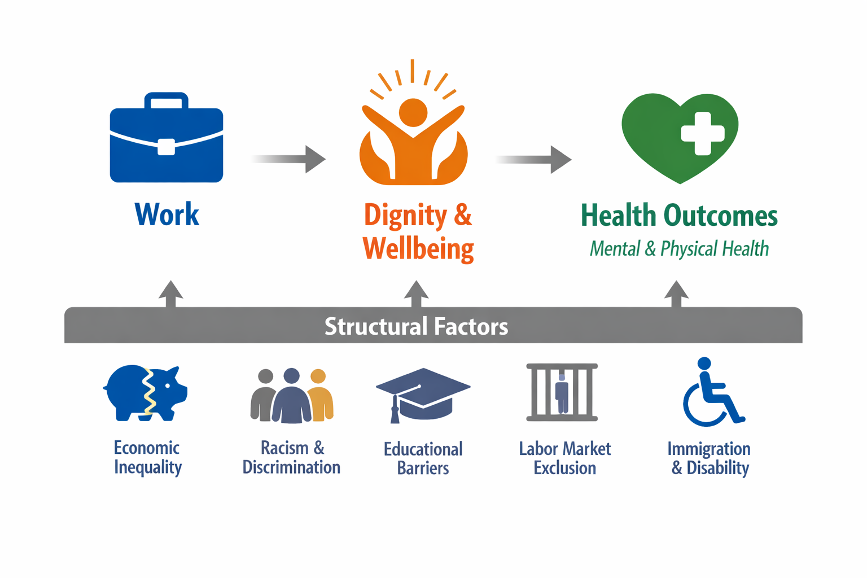
Lab Framework
Grounded in vocational psychology and the Psychology of Working Theory, the lab advances a dignity-centered framework for understanding how labor institutions shape psychological functioning and wellbeing. We begin from the recognition that individuals do not enter labor systems on equal footing. Workers experience different degrees of structural vulnerability shaped by poverty, racialized inequality, immigration status, disability, and other forms of systemic marginalization.
Within these contexts, labor institutions communicate signals about human worth through policies, organizational norms, productivity expectations, and everyday workplace practices. Workers interpret these signals through dignity appraisal—the process through which people evaluate whether their worth and contributions are recognized or treated as conditional. From this perspective, work is not simply employment. It is a social determinant of health that organizes opportunity, dignity, belonging, and human flourishing.
Lab Research Areas
Structural Inequality and Opportunity
The lab examines how economic precarity, labor market exclusion, and systemic marginalization shape opportunity, vocational development, and wellbeing across the lifespan.
Work, Dignity, and Wellbeing
A central focus of the lab is understanding how work conditions and institutional environments shape dignity, belonging, and psychological wellbeing.
Institutions, Worth, and Human Flourishing
The lab studies how social and labor systems communicate value through policies, expectations, and everyday practices, and how these experiences shape identity, engagement, and mental health.
Community-Engaged and Cross-Cultural Research
The lab is committed to research that is culturally responsive, globally attentive, and connected to the realities of underrepresented communities.
Training and Mentorship
The lab trains graduate and undergraduate researchers to conduct structurally informed, justice-oriented science. Students develop skills across quantitative, qualitative, and mixed-methods research while learning to situate vocational experiences within broader social and economic structures.
Working With Us
We welcome students and collaborators interested in vocational psychology, structural inequality, dignity, mental health, and community-engaged research.
Our Team

Gabriel Ezema, PhD
Gabriel Nnamdi Ezema is an Assistant Professor of Counseling Psychology at the University of Memphis and Director of the Work, Dignity, and Health Lab. His research examines work as a social determinant of health, with particular attention to structural inequality, dignity, vocational development, and psychological wellbeing.
Director

Alona Armour
Alona Armour is a Licensed Clinical Social Worker and graduate researcher interested in how early adversity shapes career development in marginalized communities, as well as the mental health of Black young adults.
Graduate Research Team Member

Kaley Fluke
Graduate Research Team Member
Kaley Fluke is interested in identity, meaning-making, and how individuals navigate uncertainty during periods of transition. Her work reflects an effort to bridge creative, clinical, and research perspectives.
Website:

Shantta Robertson
Graduate Research Team Member
Shantta Robertson is interested in the effects of race on neurodevelopmental assessments/ diagnoses, as well as anything pertaining to college students' mental health.

Nzinga Jones
Nzinga Jones is interested in researching and administering cross-culturally validated neuropsychological assessments for ethnically diverse and underrepresented populations, along with investigating the sustained impact of racial disparities in mental health outcomes.
Graduate Research Team Member